

Introduction – Why AI is the New Gold Rush
We’re living in a time where Artificial Intelligence (AI) is becoming the new gold rush. Just like the internet opened up a wave of opportunities in the 1990s, AI is now doing the same—but at a much faster speed. The difference? Back then, you needed technical skills, expensive equipment, and years of trial and error. Now, with AI tools, almost anyone with a laptop or even a phone can tap into income streams that barely anyone else knows about.
Most people think AI is just for big tech companies, chatbots, or maybe creating some quick blog posts. But the truth is, there’s a whole underground world of ways to earn money with AI that remain largely untapped. These aren’t the generic “write blogs with ChatGPT” or “make YouTube scripts” kind of ideas. I’m talking about creative, smart, and often overlooked ways you can use AI to generate real income—whether as a side hustle or even as a full-time gig.
So, if you’ve ever wondered how people quietly make money with AI while everyone else is still figuring out prompts, this is your map. Let’s dive into a few of the hidden AI income streams no one talks about.
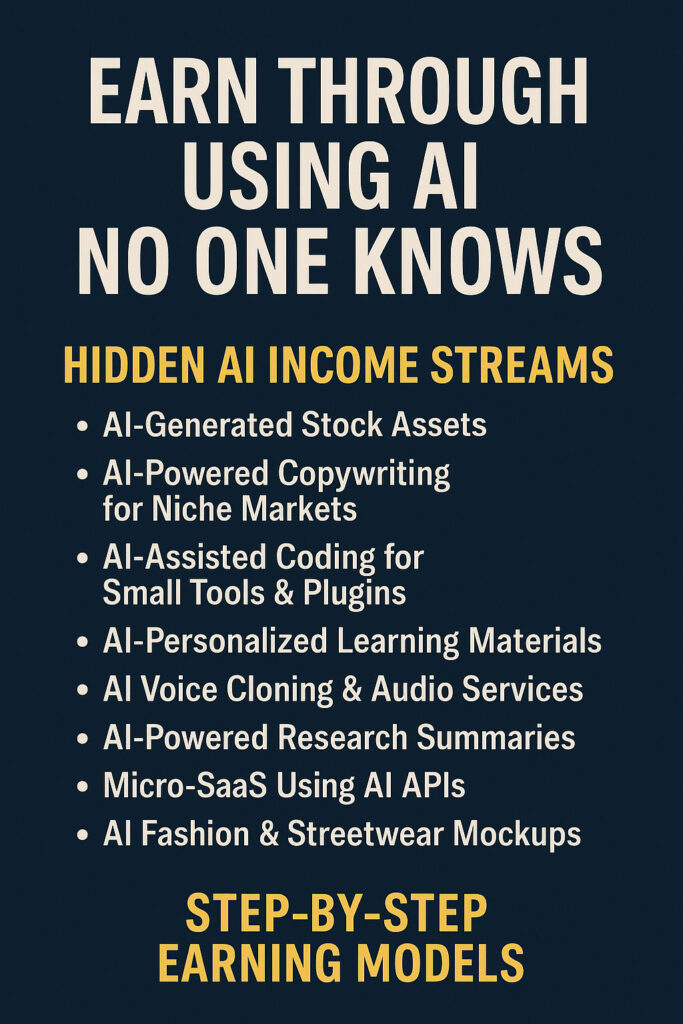
Hidden AI Income Streams

1. Selling AI-Generated Stock Assets
Stock photography used to be the domain of professional photographers with expensive cameras. But now? You don’t need a camera, lighting, or a studio. AI can generate high-quality, unique images in seconds. And here’s the secret—stock websites like Adobe Stock and Creative Market accept AI-generated content as long as it meets quality guidelines.
Imagine this:
- A designer needs futuristic cityscapes for a sci-fi poster.
- A teacher needs medical diagrams for a class.
- A YouTuber wants abstract backgrounds for their videos.
Instead of hiring someone, they head to stock websites and buy images. That’s where your AI-generated work comes in.
💡 How to make money here:
- Create packs of themed images (e.g., “Cyberpunk Backgrounds Pack” or “Eco-Friendly Lifestyle Set”) and upload them to stock platforms.
- Go beyond still images—AI can now generate short video clips and textures you can sell on stock video sites.
- Focus on niches that are underserved but in demand, like futuristic mockups, science illustrations, or infographics.
This works because businesses need constant fresh visuals, but not everyone has the time or skills to make them. You become their shortcut.
2. AI-Powered Copywriting for Niche Markets
Sure, everyone knows AI can write articles. But here’s the twist: general content is everywhere. What businesses actually want is niche, specialized writing that feels tailor-made.
Think about it:
- A coffee shop owner doesn’t care about a 1,000-word blog post. They want Instagram captions that attract customers.
- An Etsy seller doesn’t need essays. They need catchy product descriptions that convert browsers into buyers.
- Job seekers don’t want generic resume templates. They want AI-personalized resumes and cover letters for their field.
That’s where you step in.
💡 How to make money here:
- Offer “niche writing packs” like “365 Instagram captions for coffee shops” or “50 ready-to-use product descriptions for Etsy jewelry stores.”
- Sell them on marketplaces like Fiverr, Gumroad, or even Etsy.
- Provide on-demand services where clients pay you to quickly generate tailored content using AI.
This works because most small businesses don’t have time (or money) to hire marketing agencies. You can provide them with affordable, ready-to-use content that saves them hours.
Not every app needs to be the next Facebook. In fact, the money is often in tiny, useful tools that solve one specific problem. Thanks to AI coding assistants like GitHub Copilot and ChatGPT, you don’t need to be a pro developer to make them.
Examples:
- A Chrome extension that summarizes long articles in one click.
- A WordPress plugin that auto-generates SEO-friendly descriptions.
- A study tool that instantly turns notes into flashcards.
💡 How to make money here:
- Sell the tool directly with a one-time fee or subscription.
- Upload free versions to app stores and charge for premium features.
- Even release it open-source, then monetize with add-ons or donations.
People love productivity boosters. And because you’re targeting micro-problems, you’re not competing with giant companies. You’re just solving small headaches for lots of people—and that adds up.
4. Personalized Learning Materials with AI
Education is another goldmine. Instead of generic worksheets or YouTube tutorials, students want personalized help. That’s where AI shines.
Imagine:
- A medical student uploads their notes and gets custom case studies generated.
- A high schooler gets AI-created quizzes tailored to their weaknesses.
- A language learner gets AI flashcards that adapt to their progress.
💡 How to make money here:
- Sell study packs on platforms like Teachers Pay Teachers.
- Offer a subscription service where learners get personalized materials every week.
- Create exam-prep flashcards (SAT, IELTS, medical exams) and sell them online.
This works because traditional education is one-size-fits-all. AI allows you to create customized learning experiences quickly—and people will happily pay for resources that feel like they’re made just for them.
5. Voice Cloning & AI Audio Services
One of the most underrated uses of AI right now is in voice cloning. With modern AI tools, you can generate natural, human-like voices that sound professional, warm, or even celebrity-like. And the best part? You don’t need expensive microphones, a studio, or years of training in voice acting.
Imagine this:
- A YouTuber needs a voiceover but can’t afford to hire a professional.
- A small business wants a custom voicemail message or an explainer video.
- An indie game developer needs characters voiced on a budget.
AI voice tools like ElevenLabs, Murf, and Play.ht make this possible.
💡 How to earn from it:
- Offer affordable voiceover services on Fiverr and Upwork.
- Create packs of pre-recorded AI voices for specific needs (e.g., meditation guides, audiobooks, e-learning).
- Build a side business making custom voicemail or IVR (Interactive Voice Response) systems for small businesses.
This works because audio content is exploding—podcasts, YouTube, TikTok, online courses—and not everyone has a great voice. With AI, you can fill that gap.
6. Research Summaries with AI
Professionals—from lawyers to doctors to entrepreneurs—are drowning in information. Reports, articles, case studies… it’s overwhelming. But AI can summarize and organize this data in ways that save hours of work.
For example:
- Lawyers need case law summarized.
- Startups want competitor research broken down.
- Students need long academic papers simplified.
💡 How to earn from it:
- Offer “AI research assistant” services on freelancing platforms.
- Sell ready-to-use industry reports in niches like tech, healthcare, or finance.
- Package AI summaries into newsletters (e.g., “Weekly AI Digest for Marketers”).
This works because time is money, and people will pay for someone (or something) that saves them hours of reading and digging.
7. Micro-SaaS with AI APIs
SaaS (Software as a Service) sounds intimidating, but thanks to AI, you can now build micro-SaaS businesses that are simple yet profitable. Instead of creating a huge platform, you focus on one small, useful service.
Example ideas:
- An AI-powered resume grader that gives instant feedback.
- A tool that creates personalized workout or diet plans.
- A website that generates social media content calendars with one click.
💡 How to earn from it:
- Charge small subscription fees ($5–$20/month).
- Build once, then let AI handle most of the heavy lifting.
- Sell premium upgrades like detailed reports or extra features.
The secret here is that people love paying small monthly fees for convenience. Multiply that across hundreds (or thousands) of users, and it adds up to a real income stream.
8. Fashion & Streetwear Mockups
This one is perfect if you’re creative—or even better, if you already run a clothing brand. AI can generate hyper-realistic clothing mockups that look like they were shot in a professional studio. No models, no photoshoots, no expensive cameras.
Examples:
- T-shirt designs shown on real-looking models.
- Entire lookbooks created digitally before you even print the clothes.
- Unique fashion concepts (streetwear, luxury, vintage) rendered with AI.
💡 How to earn from it:
- Sell design mockup services to clothing brands.
- Create your own clothing line using AI visuals for marketing.
- Sell fashion design packs on marketplaces.
This works because fashion brands spend a fortune on photoshoots and marketing. With AI, you can give them high-quality visuals at a fraction of the cost.
Step-by-Step Earning Models
Now that we’ve seen the hidden ways AI can make money, let’s break down the step-by-step approach to actually turning these ideas into income.
- Pick Your Lane
Don’t try everything at once. Choose one area—stock assets, copywriting, micro-SaaS, etc.—and start small. - Start with Free AI Tools
Many AI platforms have free tiers. Use them first to practice and build your initial portfolio. - Build Simple Packages
Instead of doing random gigs, make clear, sellable offers. For example:- “20 AI-generated Instagram captions for $10”
- “AI-powered study guide pack for $15”
- “Custom AI voiceover under 3 minutes for $20”
- List Your Services Everywhere
Use Fiverr, Upwork, Gumroad, Etsy, or even your own website. The more places you’re visible, the more clients you’ll attract. - Scale Up Slowly
Once you get sales, reinvest in better tools and maybe even automation. Over time, you can grow from side hustle money to serious income.
Case Studies – Real People Earning with Hidden AI Skills

Reading about “ways to earn with AI” is inspiring, but it becomes real when you see how ordinary people are already doing it. Let’s look at some stories (names changed for privacy) that show what’s possible.
Case Study 1: The Freelancer Who Sells “Content Packs”
Sarah, a 24-year-old student, started experimenting with AI writing tools while working part-time. Instead of offering generic writing services (like blog posts), she created content packs:
- 365 Instagram captions for coffee shops
- Product description bundles for Etsy jewelry sellers
- Pre-written email templates for fitness coaches
She listed them on Gumroad for $15–$25 each. Within 6 months, she had sold over 1,000 packs. That’s more than $15,000 in sales—without writing each caption or description by hand.
👉 Lesson: Selling ready-made packs is smarter than only doing one-on-one gigs. You create once, sell many times.
Case Study 2: The AI Voiceover Side Hustle
James, a college lecturer, discovered an AI voice tool called ElevenLabs. He started offering affordable voiceover services for YouTubers and small businesses. At first, he charged $20 for a 3-minute script. Clients loved it because the quality was good and the delivery was fast.
Soon, he expanded to offering full audiobook narration using cloned voices, charging $300+ per project. Now he earns an extra $1,500–$2,000 a month on top of his salary—working just a few hours weekly.
👉 Lesson: AI lets you enter industries (like voice acting) that normally take years of training.
Case Study 3: The Micro-SaaS Developer
Priya, a self-taught coder, built a small AI tool that turns lecture notes into flashcards. She uploaded it as a simple web app, charged $5/month, and marketed it on TikTok. Within 4 months, she had 700 subscribers. That’s $3,500 in monthly recurring revenue.
The app isn’t fancy—it just does one thing well. But students love it because it saves them hours.
👉 Lesson: You don’t need to build a big app to succeed. Small, simple tools can bring in consistent income.
Case Study 4: AI Fashion Mockups for a Clothing Brand
Leo runs a small streetwear brand. Instead of hiring models and photographers for every collection, he used AI to generate fashion mockups that look like real studio shoots. He uploaded the designs on Instagram and Shopify.
The visuals were so realistic that his followers thought they were actual photoshoots. Result? His pre-orders doubled without him spending on photography.
👉 Lesson: AI saves costs and boosts sales. If you’re in e-commerce, visuals sell the product before the product even exists.
Why These Work (and Why Most People Fail)
You might be thinking: If AI is so powerful, why isn’t everyone rich from it already?
Here’s the truth:
- Most people only use AI for generic stuff. They ask ChatGPT for blog posts or generic images—but don’t go deeper into niches.
- They don’t package it well. Clients don’t want “AI content.” They want a polished solution—whether it’s captions, mockups, or a ready-to-use tool.
- They give up too early. Like any business, it takes a little consistency to see results.
The people making real money are those who:
- Focus on specific problems instead of trying to sell “AI” itself.
- Build reusable assets (packs, tools, templates).
- Keep improving their offers with feedback.
Future-Proofing Your AI Earnings
Now let’s talk about the elephant in the room: AI is moving so fast that what works today might get saturated tomorrow. How do you stay ahead?
1. Don’t Sell the Tool, Sell the Result
Anyone can access AI tools, but not everyone knows how to get the right output. If you position yourself as the person delivering results (e.g., “Get 100 social media captions ready-made”), you stay valuable even if the tools change.
2. Build a Brand Around It
If you’re just another Fiverr seller, you’re replaceable. But if you’re “The AI Copywriting Pro for Fitness Coaches” or “The Voiceover Guy Who Never Sleeps,” you stand out.
3. Learn How to Add Your Human Touch
The best AI entrepreneurs don’t just press a button and sell the output. They edit, polish, and add creativity. That little extra effort makes your product stand out from lazy competitors.
4. Stay Updated with New Tools
Every month, new AI platforms launch. Some flop, but others open brand-new income opportunities. Follow AI newsletters, YouTubers, and online communities to stay ahead of the curve.
5. Think Long-Term
Instead of only chasing quick gigs, build assets that earn over time—like digital packs, subscription tools, or online courses. Passive income is the real game-changer.
Bringing It All Together
We’ve covered a lot—from stock images and niche copywriting to voice cloning, micro-SaaS, research summaries, and even AI-powered fashion mockups. What do all these opportunities have in common?
They don’t rely on being a technical genius or having thousands of dollars to invest. Instead, they rely on three simple principles:
- Spot the gaps – Look for areas where businesses or individuals need help but don’t have time, skills, or money to do it themselves.
- Leverage AI tools – Use AI not as the product itself, but as the engine that helps you deliver solutions quickly.
- Package the result – Clients don’t care if you used AI. They care about getting captions, visuals, research, or tools that save them time and make their lives easier.
That’s the big secret: people aren’t paying for “AI.” They’re paying for outcomes.
The 7-Day Action Plan to Start Earning with AI
If you’re serious about turning this knowledge into money, here’s a simple step-by-step plan you can follow in the next week.
Day 1: Pick Your Lane
Decide which AI income stream excites you most. Don’t overthink it. Just choose one—stock images, copywriting, research summaries, etc.
Day 2: Explore the Tools
Try 1–2 free or trial AI tools for your chosen lane. Example:
- Stock assets → MidJourney, Leonardo AI
- Copywriting → ChatGPT, Jasper AI
- Voice cloning → ElevenLabs, Murf
- Micro-SaaS → Replit, GitHub Copilot
Day 3: Create Your First Sample
Make one complete product. For example:
- A 20-image stock pack
- A set of 15 Instagram captions
- A 3-minute AI voiceover demo
- A basic web app or Chrome extension
Day 4: Polish & Package It
Add a human touch. Edit, design, and package your product so it looks professional. Remember: presentation matters.
Day 5: Upload to Marketplaces
List your service or product on platforms like Fiverr, Etsy, Gumroad, or Upwork. The goal is to get visible.
Day 6: Promote It
Share your offer on social media, Reddit, or in online communities related to your niche. You don’t need ads—just start talking about it.
Day 7: Get Feedback & Improve
Your first version won’t be perfect. That’s fine. Take any feedback, improve your offer, and make version 2. Consistency beats perfection.
Mindset: Think Like an AI Entrepreneur
The biggest mistake people make is thinking AI itself is the business. It’s not. AI is the tool. The business is solving real problems and delivering value.
An AI entrepreneur doesn’t ask, “What can I make with this tool?” Instead, they ask, “What do people need, and how can AI help me give it to them faster, cheaper, and better?”
That’s how you stay ahead while others are stuck writing generic blog posts with ChatGPT.
Final Thoughts – The Opportunity Window
Right now, we’re in a unique moment in history. AI is still new. Most people are either unaware of its potential or think it’s only for tech companies. That means there’s a window of opportunity for those who move early.
- In 1999, people who learned to build websites quietly became millionaires.
- In 2008, people who jumped on social media marketing grew massive agencies.
- Today, those who learn to earn with AI—especially in the hidden, overlooked ways—will be the ones telling success stories a few years from now.
The question is: will you be one of them?
AI doesn’t need you to be an expert coder, designer, or marketer. It just needs you to be curious, willing to experiment, and brave enough to start.
Because the truth is—while most people are still asking, “Can AI take my job?”—a small group of smart people are already asking, “How can AI fund my lifestyle?”
And those are the ones quietly earning while nobody else notices.








2 Comments
1iqlqb
fcf6xx